StrategicPlanning
Why are we doing this?
For single-mindedness. Strategic planning is quite simply the best single mechanism available to you for the alignment and engagement of everyone in your organisation around a common purpose. A strategic planning system is the best way of keeping everyone aligned and engaged. Which explains why the development and implementation of a strategic plan is one of the CEO’s primary responsibilities. It’s at the heart of good governance.
The balancing act of corporate performance
A key challenge for organisations in today’s world is to succeed in balancing two parallel, competing imperatives:
- To maintain current business operations – profitability, service quality, customer relationships, brand loyalty, productivity, market confidence etc. What we term ‘business as usual’
- To transform business operations in order to survive and compete in the future – looking forward and deciding how business change can be introduced to best effect for the organisation.
As the pace of change (technology, business, social, regulatory etc) accelerates, and the penalties of failing to adapt to change become more evident, the focus of management attention is inevitably moving to achieve a balance between business as usual and business change.” (PRINCE2, 2009)
So organisational planning is a balancing act – between sustaining ‘business as usual’ (in order to perform now), and transforming it (in order to perform in the future). The two planning systems, BAU and strategic, are complementary, and they are interactive.
“You’ve got to eat while you dream. You’ve got to deliver on short-range commitments, while you develop a long-range strategy and vision and implement it. The success of doing both. Walking and chewing gum if you will. Getting it done in the short-range, and delivering a long-range plan, and executing on that.” – Jack Welch, retired Chairman and CEO of GE
For further explanation please see our YouTube video: Corporate Performance: The Balancing Act.
What is a strategic plan anyway?
A strategic plan is a plan for organisational transformation to ensure future performance. The nature and extent of that transformation depend on the organisation’s microenvironment and macroenvironment – current, and prospective. The planning horizon depends on the lead time required to make whatever changes are required.
“Strategic planning is the process of bringing people together to think critically about issues whose resolutions are keys to the success and long-term sustainability of organizations.”
The strategic planning process involves the candid confrontation of critical issues by key participants in order to build personal commitment to stated organisational intentions.
It follows that strategic decisions involve the commitment of substantial resources, their implementation may take several years, their impacts are felt for several years, and they are not easily reversible. So it’s worth getting them right.
Why have a strategic plan?
The purpose of strategic planning is to ensure that your organisation continues to engage with the future on favourable terms. And organisations, of course, are people – people in special purpose groups; so it’s the people, individually and collectively, who determine future performance, through the purpose that they pursue, the priorities that they set, and the values that they hold. Strategic planning is about including those people in a conversation. We like what Morgan Ramsay from the US Entertainment Media Council had to say, in response to a critic of strategic plans:
Why the A1P2 approach?
We needed a name to identify how we as a thought practice approach strategic planning with the clients that we serve.
We settled on A1P2.
The A1P2 approach is about bringing specific competencies to each unique organisational context, with the confidence, born of experience, that generally some things work, and some things don’t, when it comes to effective strategic planning.
The things that work have been fitted together and documented as a structured default process methodology with several interrelated modules.
The methodology is introduced to the client organisation through process facilitation, and then continues to operate as a dynamic model of the enterprise.
The introduction is flexible and pragmatic. As thought leaders and facilitators we can be eclectic, as well as creative, in how to approach each circumstance. We keeping watching, and we keep learning.
A1 speaks of front-ranking or best-in-class. We believe that the default strategic planning process methodology that we have designed meets that test.
P2 refers to PRINCE2, a public domain world-leading approach to project management.
We put the two together to reflect our firm belief that strategy development and strategy deployment are ‘joined at the hip;’ and that since strategy deployment is essentially a project management task, our default approach should incorporate the best there is.
Organisations are systems, and like any system they have feedback loops, which operate to ramp up, or ramp down, or stabilise what is going on. Because organisations are made up of people, the feedback loops that operate to ramp up, or ramp down, or stabilise, the system (or parts of it) are behavioural.
As thought leaders we are vitally interested in identifying and studying the key formal and informal behavioural feedback loops that govern overall performance. As facilitators we bring those insights to each organisational context, in the recognition that the soft issues can often get less attention than they deserve.
We may even find ourselves saying, “I wouldn’t do it that way myself, if I were you.”
Counsel, not direction.
Leadership and direction remain the responsibility of the CEO and their team. We join that team for part of its journey.
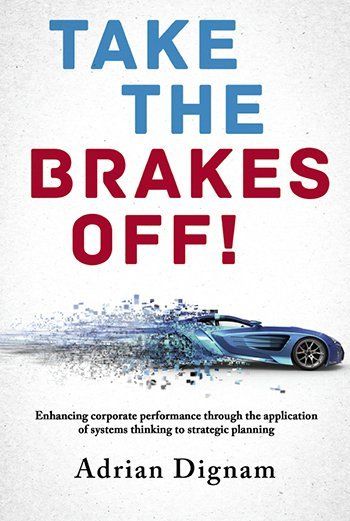
If you’re interested in learning a bit more about systems thinking and how its application to strategic planning can boost corporate performance, there’s a book that I can highly recommend
Been there. Done that.
I did my first corporate plan as a local employee of a global media organisation. There followed several years in the strategic management group of a Big Four professional advisory firm. And since founding Business Generation I have been accredited at various times to deliver many different proprietary planning and organisational development processes. And all the while I have been continuing my own learning and professional development. So I draw on a wealth of relevant practical experience, as well as my formal education and training, in the provision of the services and methodologies that we bring, of which strategic planning remains at the heart.
Over the years we have facilitated the introduction of planning systems into organisations of every description across Australia, including many well-known names.
Clients we have worked with



















We’d like you to join them.

Ready to talk it through?
Get in touch and we'll help you find the right approach for your organisation.
Or you can email us direct:
- Email:
- adrian@businessgeneration.com.au
- Phone:
- +61 2 9964 9333