M&AValueRealisation
So is it a done deal?
There are still a few things to consider before the deal is done, and they are what Business Generation is brought in to work through.

What does it take to succeed with a merger or an acquisition?
- What you pay for it
- What you can do with it once it is in your hands, and
- How you measure success.
What does it take to realise the potential value of a merger or acquisition?
- What you can do with it now that it is in your hands, and
- How you measure success.
What about what you paid for it?
Once you’ve acquired the organisation, the price becomes the denominator in the investment return equation. It’s no longer a variable.
What’s the obvious lesson here?
Don’t pay too much. The easiest way to improve an investment return is to reduce the outlay.
How much is too much?
It depends on what you’re getting, and what you believe you can do with it.
The acquisition of a listed company generally involves paying a premium for control, over and above the prevailing share price. According to the RSM Bird Cameron 2013 survey of Australian listed companies this ‘control premium’ currently averages 35.3%, up from 30.7% in 2010. A similar study by MergerStat in 2016 showed that control premiums in the US are of the same order – 27 to 34%.
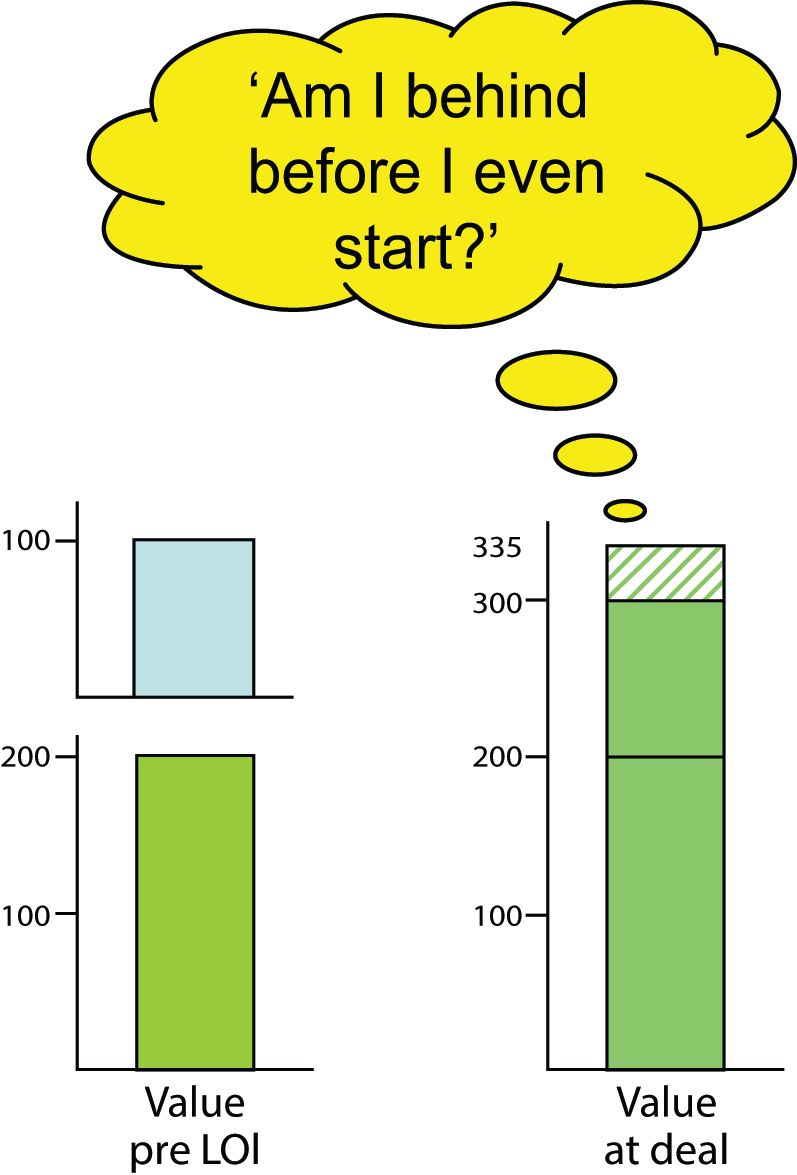
The obvious implication of anyone being prepared to pay 35% more for a company than its prevailing share price is that they believe they can improve its baseline returns more than proportionately, and/or that it offers sufficient other potential benefits to the suitor in terms of synergies or strategic options. (‘More than proportionately’ because significant risk is associated with the combining of two organisations.)
Synergies are generally categorised as either cost-based, revenue-based, or one-of:
- cost-based synergies arise principally from scale economies and operating efficiencies;
- revenue-based synergies arise principally from the leveraging of existing capabilities into new market segments and from
- market share gains in existing segments;
- one-of synergies may include the discontinuation of now-inappropriate projects, or the divestment of surplus assets.
Synergies can also be categorised as to their prospectivity:
- first-level synergies can be identified and quantified sufficiently to be incorporated in financial models and used to justify the price to be paid for the target firm;
- second-level synergies are identifiable, and may be anticipated, but are impractically difficult to quantify (at least in the early stages);
- third-level synergies are not envisaged at the time but may emerge downstream.
There is an interplay between valuation and envisioned synergies. The seller wants to harvest the synergies via the transaction. The suitor wants to harvest them afterwards:
‘And then there’s the crucial question of how much to pay for a deal and who will realize the value it creates. If the net present value (NPV) of future synergies is paid to the selling shareholders in an acquisition price premium, even the most synergistic of mergers can result in value destruction for the acquirer’s shareholders. Always consider who will be the winners in an M&A transaction, the final outcome is rarely the same for all parties.’ (AT Kearney, 2013)
Each party naturally seeks to optimise its negotiating position, so it is in the interest of the target to vaunt its existing virtues, mask its deficiencies and exaggerate the potential synergistic value of the transaction to the suitor. Caveat emptor. ‘Let the buyer beware.’ It’s the suitor’s responsibility to keep turning over the rocks, to keep asking questions, to find out where the lily has been gilded or the skeleton hidden.
The suitor in turn would prefer not to have to disclose beforehand all of the upside that he sees or suspects in the transaction; so s/he may be at pains to discount the more obvious synergies, and not to mention the others at all.
The level of disclosure is ultimately played out to respect the requirements of various stakeholders, particularly the lending bodies and the suitor’s shareholders. It is they who need to be persuaded. It is to them that promises about future performance are made by those advocating the merger or acquisition, ie the CEO and the board.
In KPMG’s 2016 survey of US M&A professionals, Valuation disparity was the top-ranked challenge to deal-making.
“From this day forward, …”
Once the knot is tied, the game changes. It’s no longer about valuation disparity. Now it’s about delivering on the promise – whatever the denominator!
In merger integration two things are critical: focus, and speed:
- from a planning perspective, the Do nothing option would leave the acquired firm operating virtually as is; the strategic intent for the merger is however likely to call for something much more than this, in order to harvest the potential synergies and to achieve the promised performance; so those synergies, and the assumptions behind them, now need to be updated, based on the additional information now available from the acquired firm; the revalidated synergies then become the focus of the merger integration effort;
- from a planning perspective, merger integration can be done as a scratch race, from a standing start; or it can be done as a relay; if the planning starts at the same time as due diligence, it allows many decisions to be made beforehand, thereby providing significant initial momentum to the merger integration process; the interaction between due diligence and integration planning also inevitably sharpens the DD process;
- from a people perspective, it is important to remember that people are expecting change – significant change; if it is not forthcoming it simply exacerbates overall stress while simultaneously eroding the credibility of senior management.
‘Psychologically, workers in the … legacy companies are expecting change. If integration is not addressed quickly after day 1 and the two groups are left to operate in isolation independent of each other for too long, this can have a corrosive effect on morale. It can be far worse than addressing organizational restructuring too quickly. Head-hunters will call, resumes will be updated and good talent that you want to keep will leave.’ (Innovation Crescendo, 2014)
How are you tracking?
What does success look like? How is it measured?
We believe that the best measure of success is the demonstrated achievement of those specifically identified and quantified value potentials on which the original deal was struck.
If you review the various papers and articles that have been published on the success rate of M&A, you will find that many refer to capital market based indicators, such as the one year and two year pre and post completion share prices.
The evidence from such papers and articles is confronting:
- commencing in 1999, KPMG conducted a succession of six bi-annual surveys to examine M&A deals, the way they are managed and the value they represent; in the first survey, only 17% of deals added value; 30% were value-neutral, and 53% destroyed value; the 2011 KPMG study (the last of that series) showed 31% creating value, 37% neutral and 32% value-destroying; it commented that (following the GFC) the market had been ‘brought back’ to ‘a roughly equal three way split between deals that have created value, deals that have reduced value, and deals that are value-neutral’;
- a 2006 UK review of 30 years of mergers and acquisitions research reported that ‘acquisitions continue to produce negative average returns similar to those seen historically’:
- a 2007 Capgemini Consulting survey on 835 operations showed that 55 percent of mergers fail to deliver their intended value when looking at stock price performance two years after integration.
We can argue about the exact numbers. The general message is clear. To quote KPMG, ‘M&A is a notoriously difficult undertaking.’
Risky Business

In 2011 Deloitte published what it described as ‘a comprehensive empirical analysis, based on an examination of one of the world’s largest PMI (post-merger integration) data bases.’ The analysis referred to the shortcomings of capital market based measures, and deliberately took a different approach, looking not only at the extent to which targets such as cost synergies, cross selling or know-how transfer were met; but also at factors such as adherence to implementation budgets, key personnel leaving the company, implementation efficiency and social compatibility.
The analysis concluded that one of every two PMI efforts fares poorly.
The study examined over 300 factors discussed as potential risks. Along the way it dispelled several myths. It found that only 35 risk factors, which sit in four categories, are statistically significant in reducing risk. The categories are Synergy, Structural, People, and Project:
Deloitte concluded that PMI risks are driven principally by internal structural risks, firstly those arising from differences in the organisational and management structures, and secondly those with their origins in dissimilar business processes.
PMI risks are driven principally by internal structural risks, firstly those arising from differences in the organisational and management structures, and secondly those with their origins in dissimilar business processes.
The study suggested that post merger integrations can differ fundamentally from each other in terms of risk profile, and that this is correlated with success potential. As part of the analysis, post-merger integrations were grouped into one of four varietal classifications based on whether any of the risk categories for each was assessed as High Risk; the resulting analysis showed a very clear correlation between increasing risk and declining PMI success rate:
- in the Pick-up-sticks variety of mergers no categories had been assessed as High Risk. Success in turn depended on addressing all the successive challenges of integration with the right ‘touch’.
- the Dominos variety had only low to moderate risks in the Structural and People categories.
- the Poker variety were marked by ‘a high degree of heterogeneity in both organisation and process structure.’
- the Russian roulette variety manifested ‘low quality of financial figures, vast organisational and management differences, severe top management resistance and low execution plan viability.’
The implications of all this are that the odds are against all mergers; that the odds can be improved during the due diligence phase by using risk assessment to screen candidates; and that the odds can be improved during the integration phase by using the analysis to focus effort on vulnerable areas.
Lessons so far?
- Don’t pay too much
- Look under every rock
- Use a risk matrix to profile, screen and rank candidates
- Beware differences in organisational and management structures and dissimilar business processes
- Establish a performance baseline for every business involved
- Identify, describe and quantify the synergies and document assumptions during valuation
- Build a model to reflect the discrete contributions of baseline business and each synergy
- Validate the synergies and assumptions and update the model immediately following completion
- Validate the key risks and develop plans to protect the integration process from them
- Start integration planning at the same time as due diligence.
Integration planning – the key to merger value realisation
Effective integration planning is considered the number one factor in ensuring that deals work. Who says so? Deloitte, in its 2016 Year-end report.
This conclusion is echoed by others:
According to survey respondents the most important factor for the success of a deal is a well-executed integration plan. … Early planning is key to developing a well-designed integration plan. In general, many of the important post-close issues will be revealed during due diligence. (KPMG, 2011) ‘Lesson 1: Acquisition integration is not a discrete phase of a deal and does not begin when the documents are signed. Rather, it is a process that begins with due diligence and runs through the ongoing management of the new enterprise. (HBR on GE, 1998)
There is general agreement about urgency. According to a 2001 report from leadership group Roffey Park Institute, 80% of all changes that ever occur take place in the first three months of transition. Another report gives a figure of 65% at 3 months, and 85% at 6 months, for the initiation of all the changes that will ever be initiated. Post-merger integration is thus just another example of the familiar Freeze-Thaw-Freeze phenomenon: there is an opportunity window, it is short, and then the organisation settles into a new steady state.
The first implication of this is that integration planning is a relay, not a scratch race. It needs to start during the due diligence phase, in order that there is sufficient time to work through as many decisions as possible beforehand. Then on Day 1 they can be announced and promptly rolled out.
‘Speed of execution and communication were two areas identified as most in need of improvement. Four-fifths of respondents said speeding up the integration process was one of the things they would have done differently. In addition, 58% said they could have communicated more clearly the progress of the integration process to all stakeholders.’ (EY, 2013)
What are the keys to effective integration planning?
There are a lot of acknowledged experts with answers to that question, and a lot of helpful resources available on the internet.
We look at post merger integration planning as a process, and we look at it from a systems thinking perspective – as we do for strategic planning. In other words, we look to describe a repeatable, purpose-sufficient sequence of steps, and we look to anticipate and factor in the key behavioural loops that will affect the successful completion of the cycle.
We also look at post-merger integration as a project. A project is the means by which change is effected in an organisation. It is a temporary, purpose-specific organisation, that is created, governed and managed in order to deliver a pre-specified outcome. In the M&A context we recommend that it be birthed at the commencement of the due diligence process, and formally closed off when the acquired organisation is cut over and becomes part of ‘business as usual’ in the merged enterprise.
These perspectives provide some parameters for our PMI planning process and for each individual PMI project:
- Purpose : Delivery of defined benefits (quantified synergies) over time, aligned with strategic intent
- Pathway : Integration initiatives
- Timeline : Default 6 months overall; determined by whichever synergy initiative necessarily takes longest
- Milestones : Day 1, Day 100, cut-over date
- Governance : Steering committee
- Management : Integration Director
- People support : Functional and cross-functional transition teams (synergies, risks, IT)
- Admin support : Integration Management Office
‘Acquirers have been getting better at post-merger integration efforts by managing them more like other significant change initiatives with standard processes, tools and disciplines, training of a cadre of people with integration experience, and careful choice of integration managers.’ (Acquisition Solutions, 2015)
The management of some ingredients relevant to the PMI exercise itself will depend on the scope of the integration. In the case of full integration, three things require particular attention:
- an articulated and promulgated Future state/Vision for the new entity (beyond cut-over; eg in 5 years)
- preserving and building the baseline businesses
- a comprehensive communications plan (stakeholders x media x messages x frequency etc).
So much for a high-level overview of what is a very demanding exercise. Every M&A deal is different, and the challenge of the PMI planner is to mould a process that respects these proven principles while accommodating the peculiarities of a specific transaction. The evidence is clear that the application of best practice planning processes reduces uncertainty and greatly improves the likelihood of success.

Ready to talk it through?
Get in touch and we'll help you find the right approach for your organisation.
Or you can email us direct:
- Email:
- adrian@businessgeneration.com.au
- Phone:
- +61 2 9964 9333